

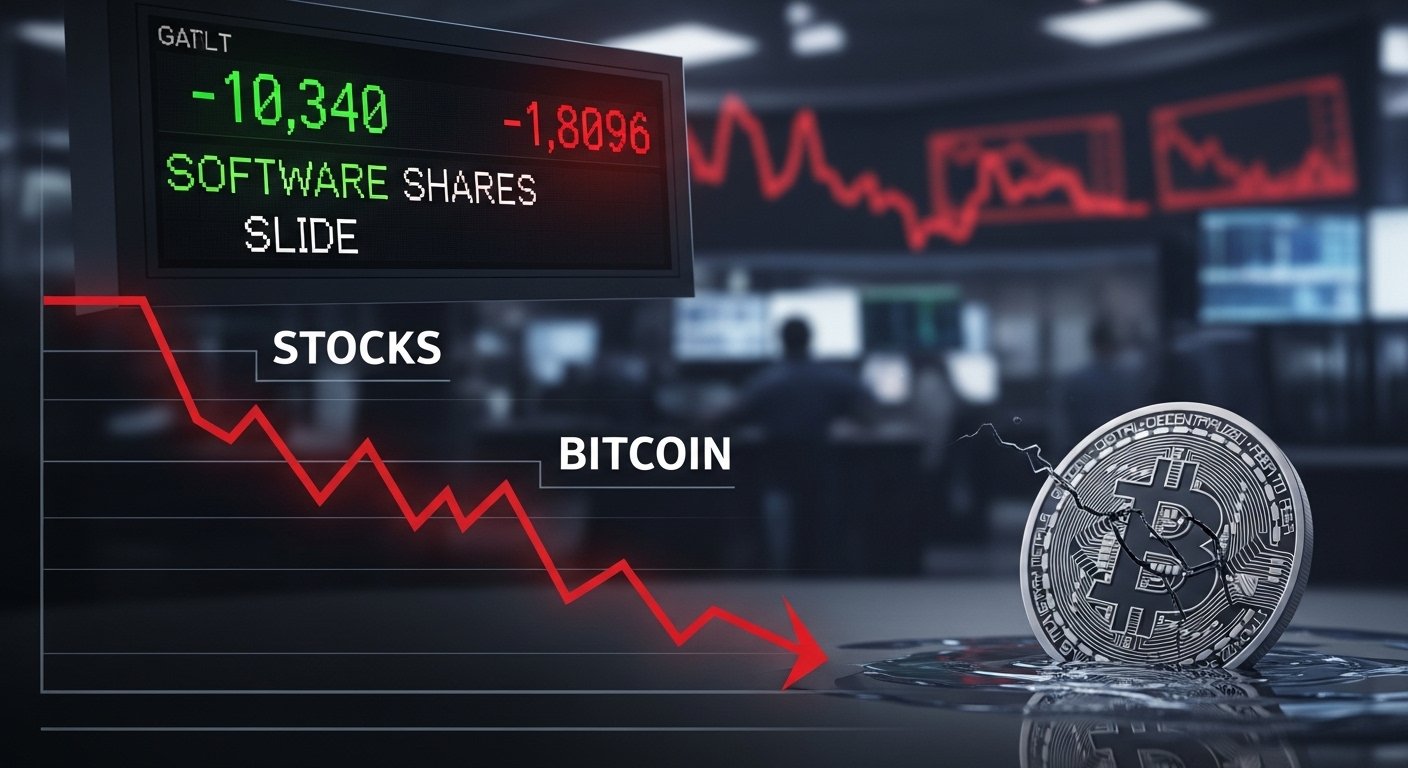
The recent downturn signals more than just a temporary pullback. It reflects shifting investor sentiment toward risk assets, particularly high-growth software companies and speculative cryptocurrencies. As volatility grips Wall Street and crypto exchanges alike, traders are reassessing exposure to tech-heavy portfolios. In this in-depth analysis, we break down why stocks and bitcoin sink as investors dump software company shares, what it means for the broader market, and how investors can navigate this evolving financial landscape.
Stocks and Bitcoin Sink as Investors Dump Software Company Shares
The phrase stocks and bitcoin sink as investors dump software company shares perfectly captures the mood currently dominating financial markets. Major indices experienced sharp declines as technology stocks—especially software companies—faced heavy selling pressure. Software firms have long been considered growth engines of the modern economy. Companies such as Microsoft, Salesforce, and Adobe have historically delivered strong returns. However, when investors begin exiting these positions, it often signals broader concerns about economic growth, corporate spending, and valuation levels.
Simultaneously, Bitcoin experienced a noticeable decline, reflecting reduced appetite for risk. The correlation between technology stocks and cryptocurrency markets has strengthened in recent years. When software shares fall, digital assets frequently follow. Several forces contributed to the sell-off:
Rising interest rate expectations have reduced the appeal of high-growth companies that rely heavily on future earnings projections. Higher borrowing costs affect both corporate investment and consumer spending, which in turn impacts software demand. Market participants also reacted to weaker-than-expected earnings guidance from key tech players. As a result, confidence in long-term revenue growth softened. The result: stocks and bitcoin sink as investors dump software company shares, creating a ripple effect across global markets.
Why Software Company Shares Are Under Pressure
Software stocks typically command premium valuations because of recurring revenue models, subscription-based income, and scalability. But when macroeconomic uncertainty increases, those premiums can quickly erode.
Investors are increasingly concerned about slowing enterprise spending. Companies facing economic headwinds often delay software upgrades, cloud migrations, and digital transformation projects. That slowdown directly impacts revenue growth for major tech firms. Additionally, tighter monetary policy from the Federal Reserve has changed market dynamics. Higher interest rates reduce the present value of future earnings, making growth stocks less attractive compared to value or defensive sectors.
This shift in sentiment explains why stocks and bitcoin sink as investors dump software company shares. Investors are reallocating capital away from high-volatility assets toward safer investments such as bonds or dividend-paying stocks. Valuation concerns also play a role. During previous bull markets, price-to-earnings ratios for many software companies reached historically high levels. Any earnings miss or negative guidance now triggers outsized reactions.
The Crypto Market Reaction as Bitcoin Drops
As equity markets declined, Bitcoin price today also trended lower. Crypto markets are particularly sensitive to liquidity conditions. When global liquidity tightens, speculative assets often experience sharp corrections.
The relationship between technology stocks and cryptocurrency has evolved significantly. Institutional investors who hold both asset classes often rebalance portfolios simultaneously. When tech stocks decline, crypto holdings may also be sold to reduce overall risk exposure.
Market observers noted increased volatility in digital asset trading. While Bitcoin remains the largest cryptocurrency by market capitalization, it has not been immune to macroeconomic pressure. The phrase stocks and bitcoin sink as investors dump software company shares underscores this synchronized movement between traditional and digital markets. It signals a broader de-risking trend rather than isolated weakness.
Impact on Major Indices and Global Markets
The sell-off extended beyond individual software companies. Major stock indices saw noticeable declines as tech-heavy components dragged down overall performance. The NASDAQ Composite, heavily weighted toward technology firms, experienced significant pressure. Meanwhile, the S&P 500 also dipped as investor sentiment weakened.
Global markets mirrored the downturn. European and Asian indices reacted cautiously, reflecting concerns about global economic growth and digital sector performance. As stocks and bitcoin sink as investors dump software company shares, portfolio diversification strategies are being tested. Investors who relied heavily on tech-driven growth are feeling the impact most acutely.
Investor Sentiment and Risk-Off Behavior
Financial markets are driven not only by data but by psychology. When fear enters the equation, selling accelerates. The current wave of volatility suggests a shift toward risk-off behavior. Investors are prioritizing capital preservation over aggressive growth strategies. Defensive sectors such as healthcare, utilities, and consumer staples have shown relative resilience.

Meanwhile, software and crypto assets—considered higher-risk—have faced disproportionate declines. This reinforces the broader narrative that stocks and bitcoin sink as investors dump software company shares amid tightening financial conditions. Volatility indicators have also risen, signaling increased uncertainty. Traders are closely monitoring inflation data, central bank statements, and corporate earnings for clues about the next market direction.
How Interest Rates Influence Tech Stocks and Bitcoin
Interest rate movements play a critical role in shaping market trends. When rates rise, borrowing costs increase, and discount rates used in valuation models climb. High-growth software companies depend heavily on projected future earnings. As discount rates rise, those projected profits become less valuable in today’s terms. Consequently, share prices fall.
Bitcoin, while decentralized, is influenced by liquidity conditions. During periods of easy monetary policy, cryptocurrencies often surge as investors seek higher returns. Conversely, when central banks tighten policy, risk assets decline. This macroeconomic backdrop helps explain why stocks and bitcoin sink as investors dump software company shares in tandem.
Earnings Reports and Market Expectations
Corporate earnings season has amplified volatility. Investors scrutinize quarterly results for signs of resilience or weakness. When major software firms issue cautious guidance, markets respond quickly. Slower customer acquisition, reduced enterprise budgets, or weaker subscription renewals all signal potential challenges ahead.
Disappointing earnings reports from tech leaders often trigger sector-wide sell-offs. Because software companies are seen as bellwethers of digital transformation trends, their performance influences broader investor confidence. This chain reaction reinforces the trend that stocks and bitcoin sink as investors dump software company shares, especially when growth expectations falter.
What This Means for Long-Term Investors
While short-term volatility can be unsettling, long-term investors may view market corrections as opportunities. Technology and software remain integral to modern business operations. Cloud computing, artificial intelligence, cybersecurity, and enterprise automation continue to drive structural growth.
Similarly, Bitcoin and other cryptocurrencies maintain dedicated investor bases who believe in long-term adoption and blockchain innovation. However, prudent portfolio management is essential. Diversification, risk assessment, and disciplined investing strategies help mitigate downturns. Even as stocks and bitcoin sink as investors dump software company shares, market cycles historically recover over time.
Strategies to Navigate Market Volatility
Investors navigating the current environment should focus on fundamentals rather than headlines. Evaluating balance sheets, cash flow strength, and competitive advantages is crucial. Companies with strong financial positions are more likely to weather economic slowdowns. For cryptocurrency investors, understanding market cycles and avoiding excessive leverage is critical. Volatility can create both risks and opportunities. Above all, maintaining a long-term perspective helps counteract emotional decision-making.
Conclusion
The current financial climate demonstrates how interconnected global markets have become. When stocks and bitcoin sink as investors dump software company shares, it reflects broader economic uncertainty and shifting risk appetite.
While volatility may persist, informed investors can adapt by focusing on strong fundamentals, diversified portfolios, and long-term strategies. Market corrections are part of the financial cycle, often paving the way for renewed growth.
See more: Cipher Digital Shares Rise 6% on HPC Rebrand, Earnings Miss
