

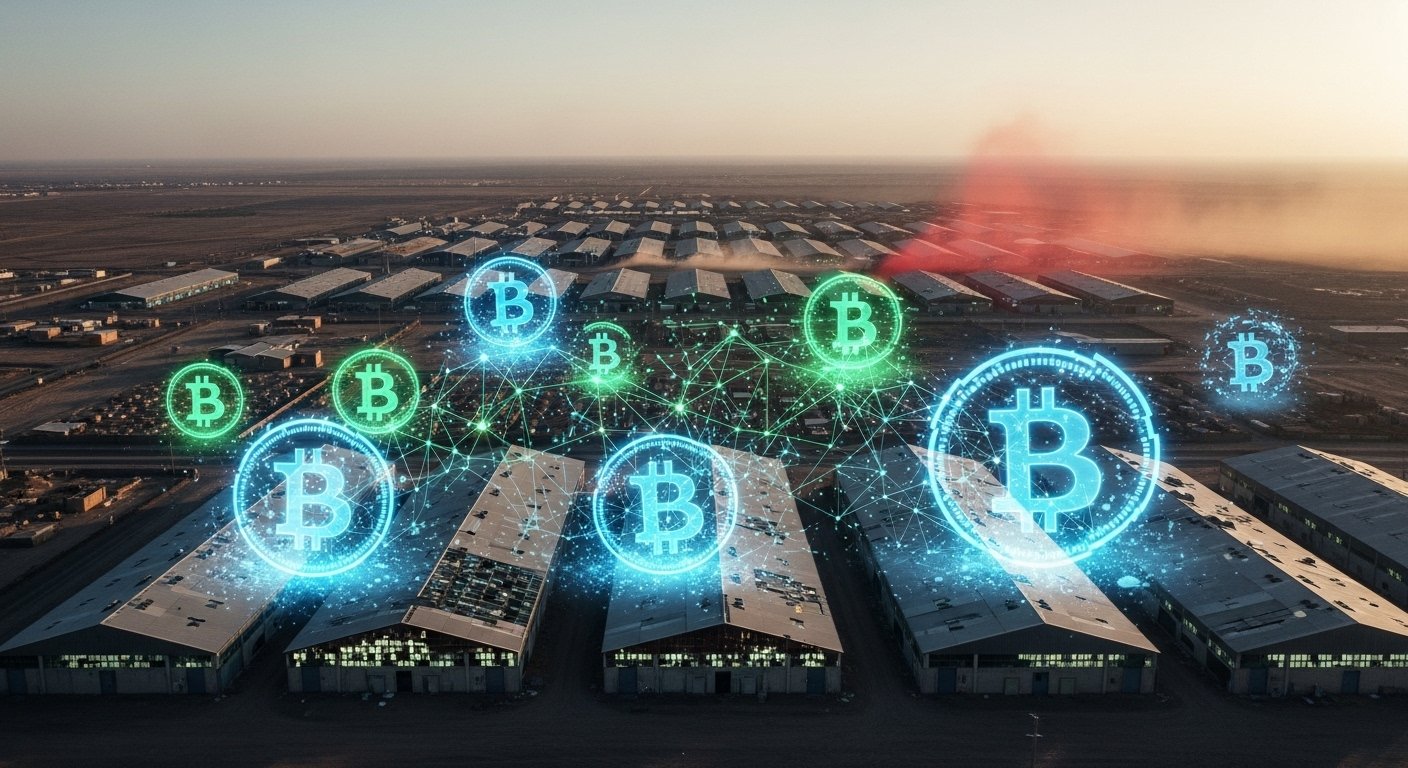
This debate has intensified amid renewed hostilities involving the United States and Israel. Analysts suggest that Iran’s mining facilities—once considered purely economic assets—could become strategic targets if they are perceived as funding sanctioned operations or strengthening Tehran’s resilience against economic pressure. The intersection of geopolitics, blockchain, and energy infrastructure now places Iran’s Bitcoin Economy squarely in the global spotlight.
The Foundations of Iran’s Bitcoin Economy
To understand the potential risks, it is crucial to examine how Iran’s Bitcoin Economy developed. Over the past decade, Iran faced sweeping sanctions that limited access to global banking systems, particularly through restrictions tied to the Society for Worldwide Interbank Financial Telecommunication. Cut off from conventional financial channels, Iranian policymakers explored alternative methods to maintain trade and currency inflows.
Bitcoin mining emerged as an attractive solution. With heavily subsidized electricity prices and an abundance of fossil fuel resources, Iran possessed the core ingredient necessary for profitable mining: cheap energy. By 2019, the government officially recognized cryptocurrency mining as a legal industry. This decision legitimized operations and allowed authorities to regulate and tax miners.
As a result, Iran’s Bitcoin Economy expanded rapidly. Industrial-scale mining farms appeared across provinces, often in converted factories or near power plants. Reports from blockchain analytics firms suggested that Iran once accounted for a notable share of global Bitcoin hash rate. Mining revenue provided an alternative stream of foreign exchange, enabling imports despite sanctions.
This strategy gave birth to what many observers describe as a sanctions-resistant crypto economy. The combination of state oversight and private operators created a hybrid ecosystem that blurred the lines between public policy and decentralized finance.
Iran’s Bitcoin Economy: Will U.S.-Israeli Airstrikes Target Its Cryptocurrency Mining Farms?
The critical question remains whether Iran’s Bitcoin Economy could become a military target. Speculation intensified following periodic air operations attributed to Israel against Iranian-linked infrastructure in the region. Although no confirmed strikes have directly targeted mining farms, the possibility is increasingly discussed in defense circles.
From a strategic standpoint, cryptocurrency mining farms represent more than rows of computers solving cryptographic puzzles. They are energy-intensive facilities often located near power generation plants, substations, or industrial zones. If policymakers view these operations as revenue streams that help Iran mitigate sanctions imposed by the United States Department of the Treasury, they could be perceived as dual-use infrastructure.
However, targeting such facilities would raise complex legal and diplomatic concerns. Mining farms are not traditional military installations. They produce digital assets rather than weapons. Any direct strike could escalate tensions and spark international criticism, especially if civilian workers are present.
The debate underscores the evolving nature of modern conflict. Financial infrastructure—particularly blockchain-based systems—has become entangled with national security calculations. Iran’s Bitcoin Economy now sits at this crossroads.
The Strategic Importance of Cryptocurrency Mining Farms
Energy Infrastructure and Bitcoin Production
Cryptocurrency mining requires immense computational power. In Iran, large-scale operations rely on electricity generated from natural gas, oil, and hydroelectric sources. This integration with the national grid means that Iran’s Bitcoin Economy is deeply intertwined with critical energy infrastructure.
Airstrikes targeting energy facilities could inadvertently disrupt mining activity even if crypto farms are not the primary objective. In past confrontations, power plants and industrial sites have been vulnerable during periods of heightened tension. If regional conflict escalates, mining centers may face indirect damage through grid instability.
At the same time, Tehran has periodically suspended mining during peak electricity demand to prevent blackouts. These interruptions highlight how politically sensitive the industry has become within Iran itself.
Revenue Streams and Sanctions Evasion
One reason Iran’s Bitcoin Economy attracts scrutiny is its potential role in sanctions evasion. By converting electricity into Bitcoin, Iran can generate digital assets that are borderless and difficult to censor. These coins can then be used to pay for imports or converted into other currencies via global exchanges.
Agencies such as the Office of Foreign Assets Control have increased monitoring of cryptocurrency transactions tied to sanctioned entities. Wallet addresses associated with Iranian actors have appeared on sanctions lists, signaling growing regulatory vigilance.
If mining revenue significantly contributes to sanctioned programs, some analysts argue it could elevate mining farms from economic assets to strategic liabilities. This possibility fuels ongoing debate about whether military planners would ever classify them as legitimate targets.
Global Crypto Markets and Geopolitical Shockwaves
The implications of potential strikes on Iran’s Bitcoin Economy extend far beyond Iran’s borders. Bitcoin operates on a global decentralized network. A sudden disruption in hash rate caused by damage to Iranian mining farms could temporarily affect network difficulty and transaction speeds.
While Bitcoin is designed to adjust to fluctuations in mining power, abrupt changes can influence investor sentiment. Geopolitical instability often drives volatility in digital asset markets. Traders monitor developments involving Iran, Israel, and the United States closely, knowing that conflict can spark price swings.

Major exchanges such as Binance and Coinbase have strengthened compliance frameworks in response to global sanctions enforcement. Increased regulatory pressure affects liquidity, onboarding procedures, and cross-border transactions.
Thus, Iran’s Bitcoin Economy is not an isolated phenomenon. It forms part of a broader narrative about cryptocurrency regulation, national security, and decentralized finance in a volatile world.
Domestic Challenges Facing Iran’s Bitcoin Economy
Even without external threats, Iran’s Bitcoin Economy faces internal pressures. Public dissatisfaction over power outages has led authorities to crack down on unauthorized mining operations. Illegal miners have been blamed for straining the national grid, prompting seizures of equipment and temporary bans.
These domestic tensions complicate the geopolitical picture. On one hand, the government views Bitcoin mining as a valuable source of foreign exchange. On the other hand, citizens question why energy resources are allocated to digital coins during times of economic hardship.
Inflation, currency depreciation, and limited access to foreign reserves have driven ordinary Iranians toward cryptocurrency as a hedge. This grassroots adoption reinforces the role of digital assets within the broader economy. If mining farms were targeted, the impact could ripple through local communities reliant on crypto-related income.
Legal and Ethical Dimensions of Targeting Crypto Infrastructure
International humanitarian law traditionally distinguishes between civilian and military targets. Cryptocurrency mining farms occupy a gray zone. They are civilian facilities generating digital assets, yet those assets may indirectly support state activities.
If Iran’s Bitcoin Economy were directly targeted, the move could set a global precedent. Other countries developing state-backed mining operations might reassess their vulnerability. The militarization of digital financial infrastructure would mark a dramatic escalation in how economic tools are treated during conflict.
Moreover, targeting mining farms could disrupt global blockchain networks used by millions worldwide. Such action would raise questions about proportionality and unintended consequences.
The Future of Iran’s Bitcoin Economy in a Volatile Region
As regional tensions ebb and flow, Iran’s Bitcoin Economy remains both resilient and exposed. The decentralized nature of Bitcoin offers some protection. Mining hardware can be relocated. Operations can scale up or down in response to risk.
However, fixed infrastructure tied to power grids is less flexible. If airstrikes were ever to target industrial zones or energy facilities, mining farms could suffer collateral damage. Whether they would be singled out deliberately remains uncertain.
What is clear is that cryptocurrency has entered the realm of geopolitical strategy. Iran’s experiment with state-aligned Bitcoin mining has redefined how digital assets intersect with sanctions, security policy, and economic survival.
Conclusion
The question of whether airstrikes might target mining farms underscores the growing strategic importance of Iran’s Bitcoin Economy. What began as a workaround to financial isolation has evolved into a pillar of economic resilience and a focal point of geopolitical tension.
As the United States and Israel weigh their security priorities and Iran continues expanding its crypto infrastructure, the future of Iran’s Bitcoin Economy hangs in the balance. Investors, policymakers, and blockchain advocates must closely monitor developments, because any escalation could reshape not only regional dynamics but also global cryptocurrency markets.
See more: Iran Crisis Exposes $7.8B Crypto Shadow Economy Network
