

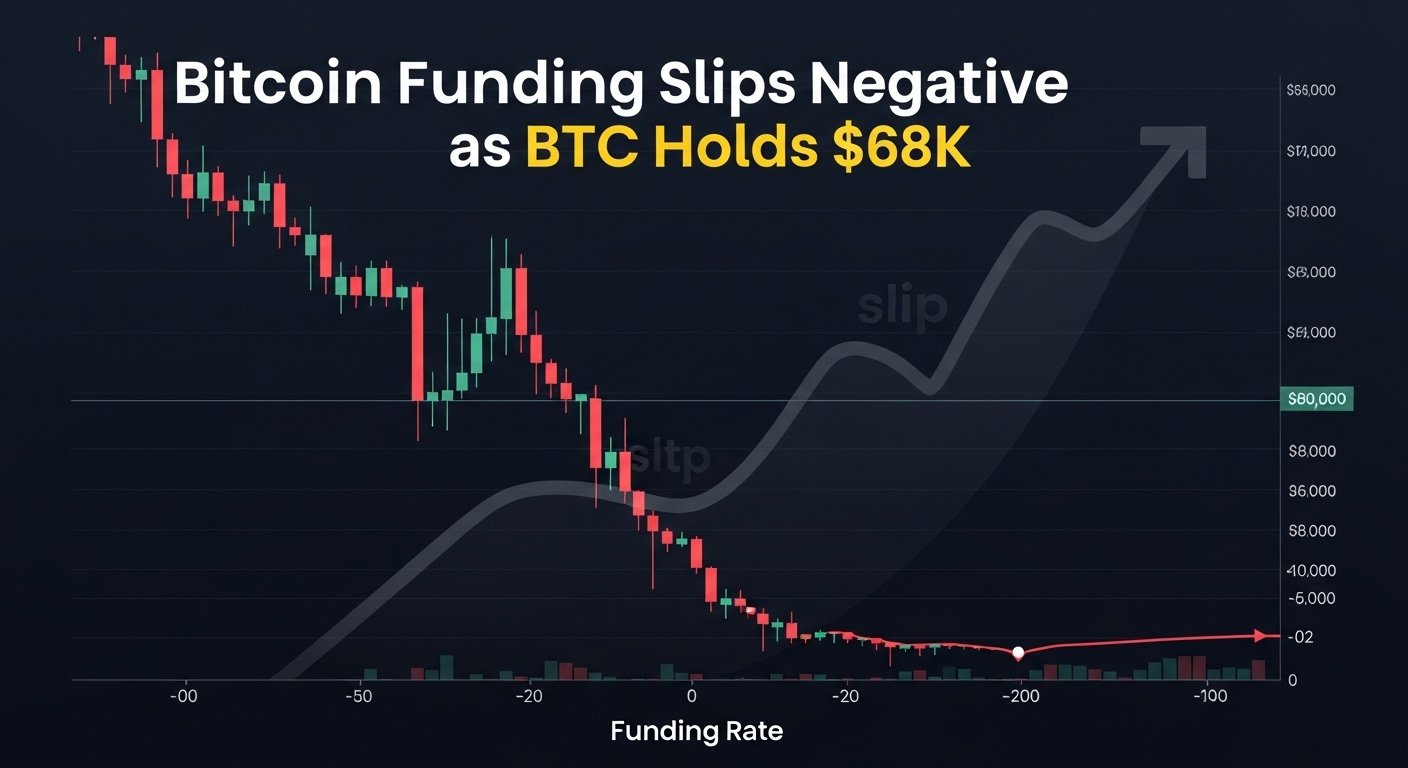
After weeks of strong upside momentum, traders are now watching derivatives data closely for clues about the next big move. Negative funding rates often signal a shift in market sentiment, particularly in the perpetual futures market where long and short traders battle for dominance.
As Bitcoin hovers near $68K, the combination of sideways price action and weakening funding suggests a cooling bullish bias—or possibly the setup for a contrarian rally. When Bitcoin funding slips negative, it indicates that short traders are paying long traders, reflecting increased bearish positioning. However, historically, such conditions have sometimes preceded sharp upside squeezes.
Bitcoin Funding Slips Negative as Market Momentum Slows
When analysts say Bitcoin funding slips negative, they are referring to the funding rate in perpetual futures contracts turning below zero. Funding rates are periodic payments exchanged between traders holding long and short positions. Positive funding means longs are paying shorts, typically during bullish phases. Negative funding means shorts are paying longs, often during cautious or bearish sentiment.
Currently, BTC is consolidating near $68,000, a key psychological and technical level. Consolidation occurs when price moves sideways within a tight range, reflecting indecision between buyers and sellers.
The combination of BTC consolidation and negative funding is significant. It shows that while price remains relatively stable, traders in derivatives markets are positioning for potential downside. This divergence between spot price stability and derivatives bearishness often leads to volatility expansion.
Bitcoin Funding Rates
What Are Funding Rates in Crypto?
Funding rates are mechanisms used by crypto exchanges to ensure perpetual futures prices remain close to spot prices. When Bitcoin funding slips negative, it signals that market participants expect downward pressure or are hedging long exposure.
For example, if many traders open short positions expecting BTC to drop, funding becomes negative because shorts must compensate longs to keep the contract price aligned with spot markets. In the current environment, negative funding suggests traders are cautious despite BTC holding above $68K.
BTC Consolidation Near $68K: A Critical Level
Bitcoin consolidating near $68,000 is not random. This zone represents previous resistance, high-volume trading activity, and a psychological milestone. When price pauses near such levels, markets often prepare for a larger breakout or breakdown.
If Bitcoin funding slips negative while price remains strong, it may indicate that bearish bets are building against a stable trend. Historically, this setup can lead to a short squeeze if BTC pushes higher, forcing shorts to close positions rapidly.
On the other hand, if price begins to break below support while funding remains negative, it could confirm broader downside momentum.
Market Sentiment Shifts as Bitcoin Funding Slips Negative
Market sentiment in crypto moves quickly. Just weeks ago, bullish euphoria dominated headlines as BTC approached new highs. Now, with Bitcoin funding slips negative, traders are reassessing risk.
Sentiment indicators show a decline in aggressive long leverage. This cooling phase is not necessarily bearish long term. In fact, excessive positive funding often precedes sharp corrections. A shift toward negative funding can reset leverage conditions and create healthier market structure. This reset phase often reduces the risk of cascading liquidations triggered by overleveraged long positions.
Historical Patterns: When Bitcoin Funding Turns Negative
Looking back at previous cycles, periods when Bitcoin funding slips negative during consolidation have produced mixed outcomes. Sometimes BTC experiences temporary dips before resuming its uptrend. Other times, negative funding acts as fuel for explosive rallies.
During bull markets, brief negative funding phases often mark local bottoms. In bear markets, sustained negative funding can signal prolonged weakness. In the current cycle, BTC remains near historically high levels, suggesting structural strength despite short-term caution.
The Role of Open Interest and Liquidations
Open interest measures the total number of outstanding futures contracts. When Bitcoin funding slips negative alongside rising open interest, it indicates new short positions entering the market.
If BTC breaks above resistance while open interest remains elevated, forced liquidations of short positions can trigger rapid price spikes. Conversely, declining open interest during negative funding suggests traders are closing positions rather than aggressively shorting.
Monitoring liquidation heatmaps and derivatives data becomes crucial during such consolidation phases.
Spot Market vs Derivatives Market Divergence
One important factor when Bitcoin funding slips negative is the divergence between spot buyers and derivatives traders. Spot investors often include long-term holders and institutional buyers. Derivatives markets are dominated by short-term traders using leverage.

If spot accumulation continues while futures traders build short positions, a mismatch develops. This imbalance can resolve with a sharp move in either direction. Currently, BTC’s ability to hold near $68K suggests that spot demand remains intact, even as futures markets lean cautious.
Macro Factors Influencing Bitcoin Consolidation
Global macroeconomic trends also shape BTC price action. Interest rate expectations, inflation data, and liquidity conditions influence risk assets.
If inflation expectations rise, Bitcoin may benefit as a hedge narrative strengthens. However, tighter monetary policy can reduce liquidity, pressuring speculative assets.
As Bitcoin funding slips negative, macro catalysts could determine whether the next move is a breakout toward $70K and beyond or a retracement toward lower support zones.
On-Chain Data and Whale Activity
On-chain metrics provide additional clarity. When funding turns negative but exchange outflows increase, it suggests long-term holders are withdrawing BTC from exchanges, reducing sell pressure.
Whale wallets accumulating during consolidation often signal confidence. Conversely, rising exchange inflows combined with negative funding may indicate preparation for selling.
The interplay between derivatives positioning and blockchain data offers valuable insight into market direction.
Is a Short Squeeze Coming?
One of the most compelling narratives when Bitcoin funding slips negative is the potential for a short squeeze. A short squeeze occurs when price rises rapidly, forcing short sellers to buy back BTC to limit losses.
If BTC breaks decisively above $68K resistance while funding remains negative, leveraged shorts may face liquidations. This could propel BTC toward new local highs. Traders closely monitor funding rate shifts in real time, as sudden flips from negative to positive can indicate squeeze dynamics unfolding.
Retail vs Institutional Positioning
Retail traders often react emotionally to short-term price fluctuations. Institutional investors typically adopt longer time horizons and risk management strategies.
When Bitcoin funding slips negative, it may reflect retail traders hedging or shorting after recent volatility. Institutions, however, may see consolidation as an accumulation opportunity. Understanding who is driving derivatives positioning is critical for anticipating volatility.
Technical Analysis: Key Levels to Watch
From a technical perspective, BTC must hold above major support zones to maintain bullish structure. A sustained move below $65K could confirm short-term weakness.
If Bitcoin funding slips negative but price continues forming higher lows, the broader uptrend remains intact. Traders look for breakout confirmation through volume expansion and momentum indicators such as RSI and MACD. Resistance above $68K remains the primary hurdle. A strong daily close above this zone could trigger renewed bullish momentum.
Crypto Market Impact Beyond Bitcoin
When BTC consolidates and funding shifts negative, altcoins often follow. Ethereum, Solana, and other major tokens may experience reduced volatility until BTC establishes direction.
Bitcoin dominance also plays a role. If BTC remains stable while altcoins weaken, capital concentration increases. If BTC rallies, altcoins may lag initially before catching up. The broader crypto market sentiment is heavily influenced by derivatives metrics tied to Bitcoin.
Long-Term Outlook Despite Short-Term Caution
Despite short-term funding shifts, Bitcoin’s long-term fundamentals remain strong. Institutional adoption, ETF inflows, and increasing global recognition continue supporting the asset class.
Periods when Bitcoin funding slips negative during consolidation often represent healthy market resets rather than structural weakness.
Patience becomes essential. Markets rarely move in straight lines. Consolidation phases build the foundation for larger trends.
Conclusion
The signal is clear: Bitcoin funding slips negative while BTC consolidates near $68,000. This combination reflects cautious derivatives positioning amid stable spot demand. Whether it leads to a short squeeze or temporary correction depends on upcoming catalysts and volume expansion.
See More: Bitcoin Bounce After 50% Drop: Traders Buy the Dip and Reset Risk