

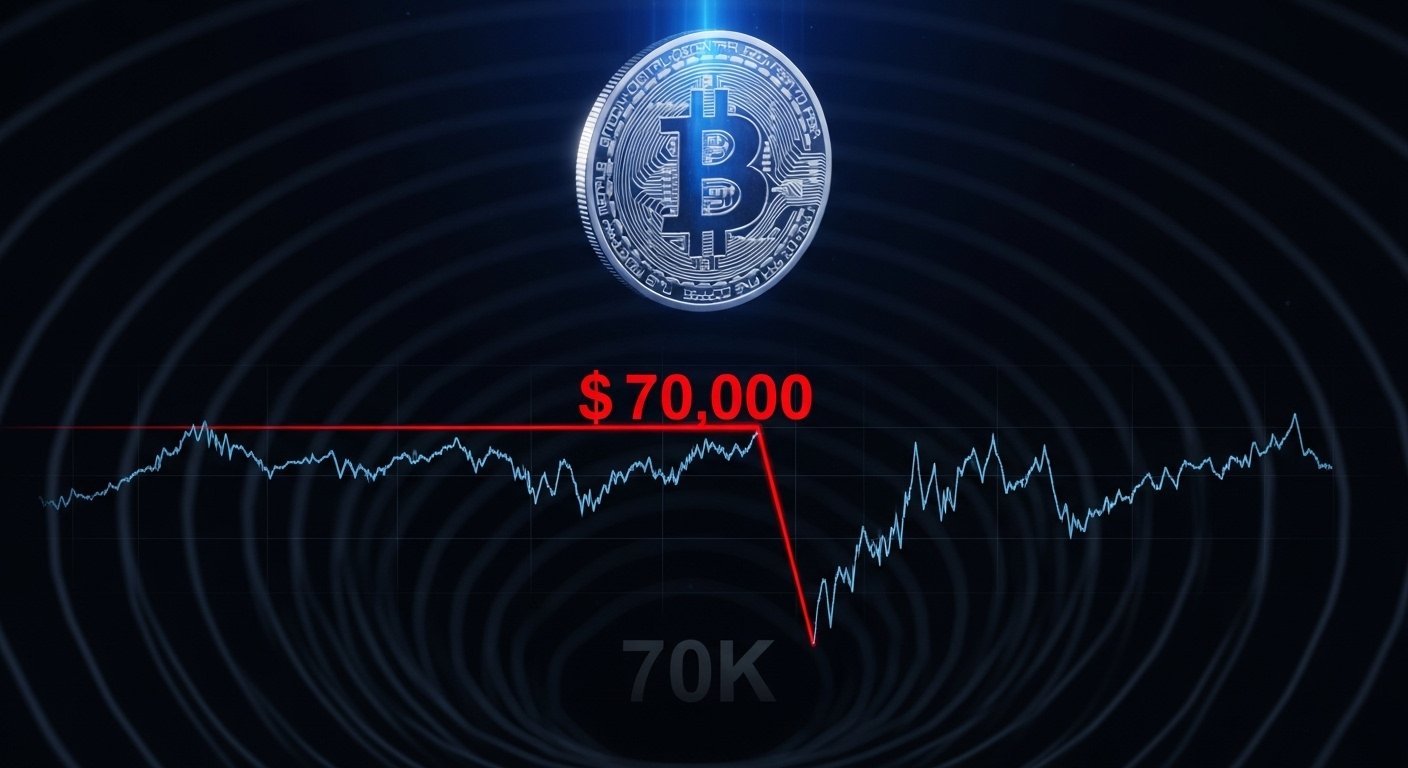
When Bitcoin drops under $70K, the market doesn’t just react with numbers on a screen—it reacts with emotion, positioning shifts, and narrative resets. Price levels like $70,000 are not magical in a technical sense, but they matter because they concentrate trader attention. They become anchor points for stop-losses, leverage thresholds, and media framing. Once that line breaks, even temporarily, it can trigger a chain reaction: short-term holders panic, derivatives traders get squeezed, and momentum funds reduce risk. At the same time, long-horizon investors often see the same moment as opportunity, not catastrophe.
This is exactly why the phrase “institutions eye entry points” keeps resurfacing whenever Bitcoin drops under $70K. In past cycles, large buyers frequently waited for fear-driven selloffs, thin order books, and forced liquidations to create better pricing. Institutions don’t usually chase candles. They prefer accumulation phases where liquidity improves, spreads tighten, and the market offers time to build positions without pushing price against themselves. A dip below $70K can be interpreted as “stress,” but it can also be interpreted as “discount,” depending on the timeframe, risk appetite, and macro conditions.
A $70K break that changed the conversation
In this context, commentary attributed to the Bitwise CEO matters because Bitwise is known for bridging traditional finance and digital assets. Whether or not traders agree with the view, the underlying idea is widely shared: when retail gets nervous, institutional research desks get busy. They start evaluating whether the selloff is primarily macro-driven, flow-driven, or sentiment-driven—and they look for signals that the market is stabilizing. If those signals appear, they deploy capital gradually, not in a single dramatic buy.
This article breaks down what it really means when Bitcoin drops under $70K, why volatility often spikes around these levels, how Bitcoin ETF and derivatives flows can magnify moves, and which signs suggest institutions are quietly preparing to step in. Most importantly, we’ll explore how to interpret the dip without getting trapped by hype or fear, and what “smart entry points” can mean in a market that never sleeps.
What it means when Bitcoin drops under $70K
When Bitcoin drops under $70K, it often reflects more than a simple supply-and-demand imbalance. It can signal a shift in market regime: from trend-following to mean-reversion, from optimism to caution, or from liquidity-rich to liquidity-tight. Understanding the “why” behind the move matters, because not all dips are equal. Some are healthy pullbacks within a broader uptrend, while others are early warnings of deeper risk.
A psychological level with mechanical consequences
Round numbers act like magnets. Traders place orders around them, media headlines reinforce them, and algorithms react to them. When Bitcoin drops under $70K, it can trigger stop orders and risk limits that weren’t active above the level. Those mechanical triggers can accelerate the decline even if the fundamental picture hasn’t changed. The move can look dramatic because the market structure amplifies it.
Volatility clusters around major support zones
Support levels attract buyers, but they also attract tests. If price revisits a zone repeatedly, liquidity can thin as traders get cautious. Then a single wave of selling can punch through support, creating a fast drop and a fast bounce—classic Bitcoin volatility behavior. That’s why dips below big levels are often noisy and emotional, which ironically is what many institutions prefer when searching for accumulation windows.
Bitwise CEO view: Why institutions watch dips, not pumps
When Bitcoin drops under $70K, the headline might scream “crash,” but institutional desks often treat it as a data point. Institutions care about entry efficiency: how to build exposure without suffering excessive slippage or buying at euphoric peaks. A dip can offer both better prices and better market conditions for disciplined accumulation.
Institutions want confirmation, not excitement
Retail traders frequently buy based on excitement and social momentum. Institutions typically buy after they see stabilization: volatility cooling, selling pressure slowing, and flows turning less negative. If Bitcoin drops under $70K and then holds near a base for days or weeks, that can be more attractive than a sudden V-shaped recovery, because it allows size to enter gradually.
Entry points are often “zones,” not exact prices
The phrase “entry points” can be misleading. Institutional buyers rarely aim for a single perfect tick. They often define a range—an entry zone—based on risk models, macro conditions, and liquidity availability. When Bitcoin drops under $70K, some funds may begin scaling in small allocations, then add more only if the market proves it can hold higher lows.
The real drivers behind the dip: macro, flows, and leverage
To understand why Bitcoin drops under $70K, it helps to separate three major forces: macro conditions, market flows, and leverage dynamics. These forces interact, and any one of them can dominate in a given week.
Macro pressure: rates, yields, and risk appetite
Bitcoin often trades like a risk asset during tightening cycles. When yields rise and cash offers attractive returns, investors reduce exposure to high-volatility assets. If traders anticipate tighter financial conditions, they may sell BTC proactively. This macro-driven selling can push price below major levels, and once Bitcoin drops under $70K, momentum traders may join the move, reinforcing it.
Flow pressure: ETF inflows and outflows matter more than headlines
Spot Bitcoin ETF products can amplify market moves. When inflows are strong, dips get bought quickly. When outflows dominate, the market can feel heavy for longer than expected. If Bitcoin drops under $70K during a period of net outflows, the selloff can deepen because the marginal buyer is less active. Institutions monitoring flow data will often wait for outflows to slow before increasing exposure.
Leverage pressure: liquidations turn dips into dumps
Derivatives markets can exaggerate everything. If longs are crowded and leverage is high, a small decline can trigger liquidation cascades. Forced selling pushes price lower, which forces more liquidations, creating a domino effect. This is one of the most common reasons Bitcoin drops under $70K suddenly rather than gradually. For institutions, a liquidation flush can be a positive sign because it clears excess leverage and resets the market to healthier conditions.
Market structure signals institutions watch after $70K breaks
When Bitcoin drops under $70K, institutions don’t just guess what happens next. They track measurable signals that reveal whether selling is ending or accelerating.
Volume and “sell exhaustion”
A key signal is whether selling appears exhausted. If price drops but volume spikes and then fades, it can suggest capitulation—many weak hands exiting at once. If Bitcoin drops under $70K on light volume, the move may be less meaningful, or it may imply liquidity is thin and risk remains. Institutions prefer evidence that sellers have “spent” their aggression.
Order book liquidity and spread behavior
Professional buyers want liquidity. They examine how quickly bids replenish and whether spreads tighten after volatility events. If Bitcoin drops under $70K and spreads widen dramatically, it suggests stress. If spreads begin tightening and bids return, it suggests stability. These are microstructure clues that matter more to institutions than social media sentiment.
Funding rates and open interest
In perpetual futures, funding rates reveal crowd positioning. If funding was very positive before the drop, it suggests longs were crowded—and the dip may be a leverage reset. If Bitcoin drops under $70K and funding normalizes while open interest declines, it often indicates a cleanup of excess risk, which can set the stage for steadier price action.
Why “institutional entry” doesn’t guarantee an instant rebound
Even if institutions are interested, the market may not bounce immediately. Large capital moves carefully, and it may require time for macro uncertainty to clear.
Allocation is gradual, not impulsive
Institutions often average in. They start small, observe price behavior, and then increase exposure. So even if Bitcoin drops under $70K and institutional buyers become active, price can remain range-bound while positions are built. This sideways grind can frustrate retail traders, but it’s a common accumulation pattern.
Institutions hedge while they buy
Many professional investors hedge using options or futures. They may buy spot exposure while shorting futures or buying put options, which reduces upside momentum in the short term. This is another reason Bitcoin drops under $70K can be followed by stabilization instead of a dramatic rally.
Macro uncertainty can override entry interest
If markets are anxious about inflation, growth, or policy, institutions may hold back even if Bitcoin looks attractive. In those situations, Bitcoin drops under $70K can be the start of a longer consolidation period rather than a quick recovery.
The role of narratives: fear sells, patience wins
When Bitcoin drops under $70K, narratives change quickly. One day it’s “new era,” the next it’s “cycle is over.” This narrative whiplash is normal in crypto, but it can be costly if you trade emotionally.
Retail reactions amplify short-term swings
Retail tends to sell after price drops and buy after price rises, which is the opposite of what disciplined strategies aim to do. This behavior increases Bitcoin volatility. Institutions often take the other side: they buy when fear is high, provided risk metrics support the move. That’s why Bitcoin drops under $70K can be a moment of institutional curiosity.
Long-term adoption continues even in pullbacks
Price is not the same as progress. Even during drawdowns, infrastructure improves: custody, compliance, market access, and product innovation. Institutions care about these foundations because they reduce operational risk. A dip doesn’t erase the broader development arc, which helps explain why Bitcoin drops under $70K doesn’t automatically scare serious allocators away.
Practical framework: How to interpret entry zones responsibly
This is not about hype. It’s about reading the market with structure.
Define your timeframe before you react
If your horizon is months to years, a move where Bitcoin drops under $70K may be noise, not a thesis breaker. If your horizon is days, it matters a lot more. Many losses come from mixing timeframes—long-term conviction with short-term leverage, or short-term trading with long-term emotional attachment.
Look for stabilization, not instant reversal
Institutions often wait for stabilization: higher lows, reduced volatility, and improving flows. If Bitcoin drops under $70K and then keeps making lower lows, “entry point” talk is premature. If the market forms a base and selling pressure fades, “entry zone” becomes more realistic.
Risk management beats prediction
No one knows the exact bottom. The most practical approach is sizing and risk control. If Bitcoin drops under $70K, a measured plan—scaling entries, limiting leverage, and respecting invalidation levels—can matter more than any single forecast.
Conclusion
When Bitcoin drops under $70K, the market is doing what it always does: testing conviction, shaking out leverage, and recalibrating expectations. The Bitwise CEO’s framing—that institutions are watching for entry points—fits how professional capital typically behaves. Institutions often prefer fear-driven environments because they offer better prices and cleaner positioning, especially after liquidations reduce excess risk.
Still, “institutions eye entry points” is not a guarantee of an immediate rebound. Institutional buying is usually gradual, often hedged, and heavily influenced by macro conditions and flow trends. The most useful takeaway is to focus on signals: ETF flows, leverage cleanup, liquidity returning, and volatility stabilizing. If those align, a dip where Bitcoin drops under $70K can shift from panic headline to calculated opportunity. If they don’t, patience remains the most underrated strategy in crypto.
FAQs
Q: Why did Bitcoin drops under $70K even with strong long-term optimism?
Because short-term price is driven by liquidity, macro conditions, ETF flows, and leverage. Even bullish long-term narratives can’t prevent selloffs when risk appetite fades and liquidations hit.
Q: What do institutions mean by “entry points” when Bitcoin drops under $70K?
They usually mean an entry zone where they can scale in over time, often after volatility cools and selling pressure shows signs of exhaustion.
Q: Do Bitcoin ETF flows affect price when Bitcoin drops under $70K?
Yes. Strong inflows can support dips, while outflows can add pressure. Institutions track these flows closely to judge whether demand is improving or weakening.
Q: Is a drop under $70K a bearish signal for the entire cycle?
Not necessarily. It can be a normal correction, especially after strong rallies. The bigger signal is whether the market stabilizes and forms higher lows afterward.
Q: What signs suggest institutions are actually buying after Bitcoin drops under $70K?
Common clues include slowing sell volume, tighter spreads, normalized funding rates, falling open interest from leverage cleanup, and steadier ETF flow behavior that indicates demand returning.
