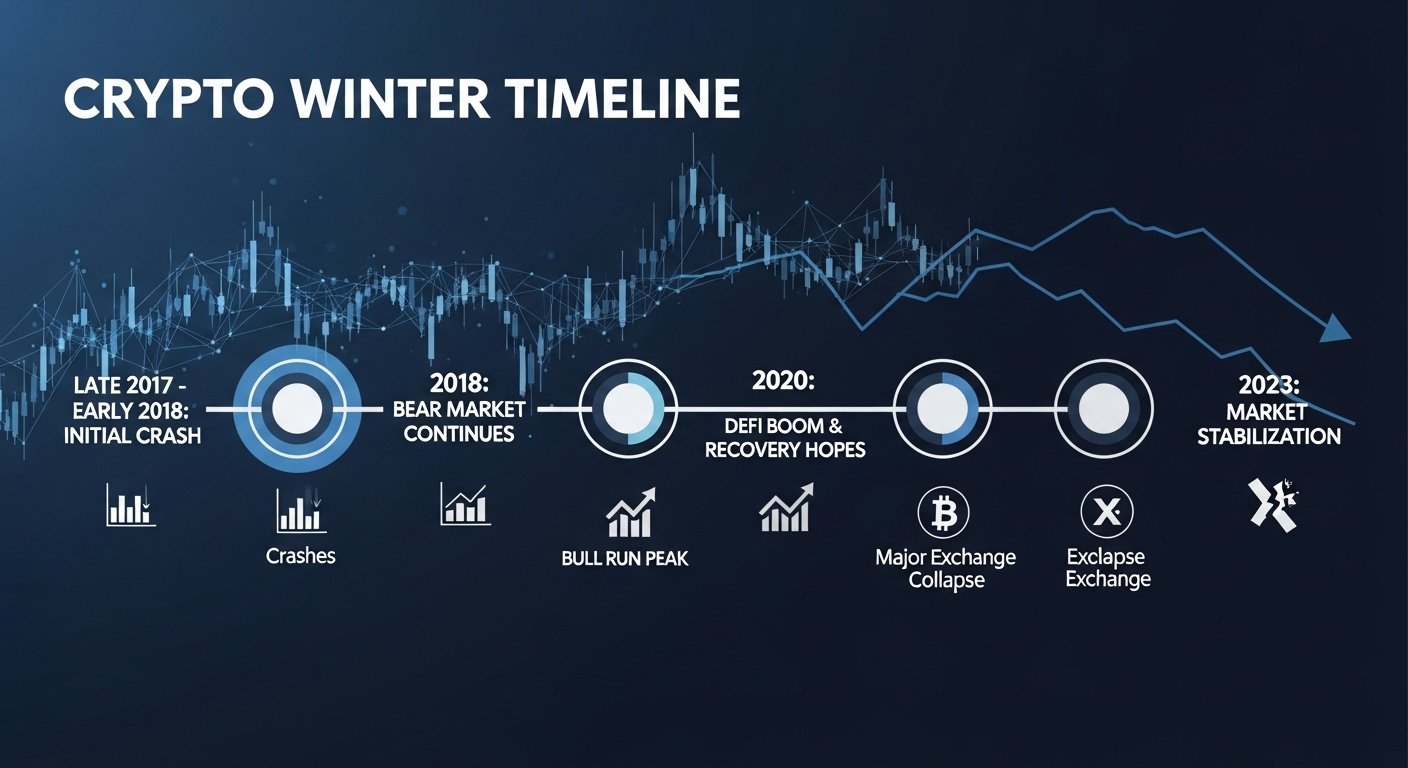
Understand crypto winter timeline, what extends bear markets, and the next Bitcoin downside level to watch using structure, data, and logic. When prices are falling, rallies fail quickly, and every headline sounds ominous, the term crypto winter starts showing up everywhere. For many people, it doesn’t feel like a market cycle—it feels like a permanent season. Portfolios shrink, excitement disappears, and even strong projects go quiet. The emotional weight of a crypto winter is real because it combines two hard experiences at once: financial pain and uncertainty about time. People can survive volatility. What breaks confidence is not knowing whether the downturn will last weeks, months, or years.
But here’s the part most traders forget: a crypto winter is not a random curse. It’s a recognizable phase of a cycle driven by liquidity, leverage, adoption pace, and macro conditions. It tends to follow a period of excess too much speculation, too much borrowed money, and too many expectations priced in. The winter phase is the market’s reset button. It removes weak hands, forces risk to be repriced, and rebuilds a base where long-term buyers can accumulate without competing against mania.
In this article, we’ll answer two questions that matter most during crypto winter: how long it may last, and what the next Bitcoin downside level to watch could be. We’ll do it in a practical, scenario-based way, focusing on how market structure typically behaves rather than making dramatic predictions. You’ll learn the signals that often mark the beginning and end of a crypto winter, how to interpret bear-market rallies, and how to identify downside levels that actually matter—levels where the market is likely to react strongly.
What is crypto winter and why does it happen?
A crypto winter is a prolonged period of depressed prices, low enthusiasm, and reduced liquidity across the crypto market, usually following a major bull run. It’s not just a few red candles. It’s a broad shift in behavior: investors become cautious, speculative capital dries up, and risk premiums expand. In this phase, the market stops rewarding hype and starts rewarding patience.
A crypto winter typically happens for three connected reasons. First, speculation peaks and leverage builds. When prices are rising fast, people borrow to amplify gains. Second, a catalyst—sometimes macro, sometimes internal—causes the market to drop, and leverage begins to unwind. Third, confidence fades and liquidity thins, making recoveries weaker and selling more effective. Over time, the market finds a lower range where forced selling ends and long-term demand slowly returns.
Understanding this matters because crypto winter is less about “bad luck” and more about a predictable reset. If you understand the reset mechanics, you can make better decisions while others are trapped in emotion.
How long does crypto winter usually last?
There is no guaranteed timeline, but crypto winter durations tend to be measured in months, not days. The market needs time to rebuild liquidity, restore confidence, and rotate from speculative holders to longer-term holders. The length depends on what caused the downturn and how quickly financial conditions improve.
The three drivers that control crypto winter length
The duration of crypto winter is largely shaped by these forces:
1) Liquidity conditions and interest rates
When money is expensive, risk assets struggle. If the broader environment is tight, crypto often stays weak longer. If conditions ease, crypto can recover faster because capital returns to higher-risk opportunities.
2) Leverage cleanup and market positioning
A deep crypto winter often requires the market to fully flush leverage and weak balance sheets. If leveraged participants are forced out quickly, recovery can begin sooner. If leverage remains hidden and keeps blowing up in waves, the winter drags on.
3) Narrative regeneration and real adoption
Crypto rallies are powered by narratives, but durable recoveries require real demand: users, infrastructure, and stronger market plumbing. A crypto winter ends when the market can sustain higher prices without needing constant hype.
Why “time pain” is part of every crypto winter
One reason crypto winter feels so brutal is that it doesn’t only create price pain; it creates boredom and doubt. Markets often grind sideways after a big drop. That sideways phase is designed—by incentives and psychology—to exhaust participants. Many people sell near the end simply because they can’t tolerate waiting. Ironically, that exhaustion is often a necessary ingredient for the next cycle.
The difference between a bear market and crypto winter
People often use the terms interchangeably, but they aren’t identical. A bear market is a downtrend. Crypto winter is the environment that surrounds that downtrend: low liquidity, weak sentiment, fewer new participants, and a general “risk-off” attitude. You can have sharp bear-market rallies during crypto winter, but the environment remains fragile until demand proves itself.
Bear market rallies: why they trick people in crypto winter
During crypto winter, rallies can be fast and convincing because short positioning gets squeezed and oversold conditions rebound. But many of these rallies fail because the market hasn’t rebuilt enough spot demand to sustain upside. In practice, crypto winter rallies often retrace a portion of the drop, then roll over when buyers run out of momentum.
What ends crypto winter? The signals that usually matter
No single indicator rings a bell at the bottom. But crypto winter tends to end when several signals start aligning.
1) Capitulation slows and selling becomes less effective
A market is healthier when bad news stops causing huge drops. During deep crypto winter, every negative headline is amplified. Near the end, the market begins to “ignore” fear because sellers are already exhausted.
2) Higher lows start to form
Even if price remains below old highs, a sequence of higher lows suggests demand is returning. This is one of the most practical signals that crypto winter is transitioning into accumulation.
3) Liquidity improves and volatility stabilizes
In the late stage of crypto winter, the market often becomes less chaotic. You may still see volatility, but it becomes less random. That stability indicates stronger hands are absorbing supply.
4) The market stops depending on leverage for upside
When gains rely on leverage, they are fragile. When gains come from spot demand, they are sturdier. A typical crypto winter ends when spot buying begins to dominate again.
The next Bitcoin downside level to watch: how to identify it correctly
Asking for the next Bitcoin downside level to watch is natural, but the answer shouldn’t be a single number thrown out for clicks. A meaningful Bitcoin downside level is one that aligns with real structure: prior consolidation, high traded volume areas, and major psychological zones where orders cluster.
The most important downside concept: “next demand zone,” not “magic number”
Rather than obsessing over one exact line, think in zones. The market rarely respects a level to the dollar. It respects regions where buyers historically stepped in. The next Bitcoin downside level to watch is typically the nearest major demand zone below current price where the market previously built a base or launched a strong move.
Three practical ways to map the next Bitcoin downside level
1) Previous range lows and breakout points
Bitcoin often retests old breakout zones. If a prior resistance became support in the past, it can become the next Bitcoin downside level during a sell-off.
2) High-volume price areas
Where the market spent a lot of time trading, it created a “fair value” region. Those regions often act as magnets in a downturn because buyers feel comfortable there.
3) Big psychological levels
Round numbers attract orders. Even when they aren’t perfect technical levels, they can become the next Bitcoin downside level simply due to how traders place orders.
The most watched Bitcoin downside level in winter conditions: the prior major base
In a true crypto winter, the level that tends to matter most is the prior major base that supported the last sustained rally. That base is where long-term holders accumulated and where the market proved demand. If Bitcoin breaks above a base and later returns in a winter phase, that base becomes the “line in the sand.”
When the market approaches that zone, three things usually happen: volatility rises, narratives intensify, and traders become split between “this is the bottom” and “it’s going much lower.” That’s exactly why it matters: it reveals the market’s true risk appetite.
What if Bitcoin breaks the next Bitcoin downside level?
If Bitcoin breaks a meaningful Bitcoin downside level, it doesn’t automatically mean collapse, but it often triggers two effects: a sentiment shock and a positioning shift. Traders who expected a bounce may exit, and those who waited for lower prices may step in slowly. The market then hunts for the next demand zone.
During crypto winter, breaks can be sharp because liquidity is thinner. But they can also become bear traps if sellers exhaust quickly and buyers reclaim the level. That reclaim is critical. In many cycles, the most important signal isn’t the break—it’s whether the market can reclaim the level and hold it.
How to survive crypto winter without emotional decisions
A crypto winter punishes impulsive behavior. Survival comes from having a plan that does not rely on perfect timing.
Use a process for entries instead of a single bet
Staged buying reduces regret. If you buy in portions, a deeper drop becomes an opportunity rather than a disaster. In crypto winter, timing is hard. Process beats prediction.
Control leverage and time horizon
If you must trade, keep leverage low or avoid it entirely. Crypto winter volatility can wipe out good ideas simply due to short-term swings. For long-term investors, ensure your position size matches your ability to wait.
Separate “price action” from “project quality”
In crypto winter, even strong assets drop. That does not automatically mean the underlying idea failed. But it does mean the market is repricing risk. Staying rational is easier when you accept that price and value can diverge for long periods.
Strategy outlook: what comes after crypto winter
Historically, after crypto winter, the market transitions into an accumulation phase where price improves slowly and skepticism remains high. That skepticism is healthy because it keeps leverage lower and forces demand to prove itself. Eventually, narratives return, adoption expands, and a new uptrend begins—usually when most people are no longer expecting it.
The key shift is psychological: during crypto winter, people ask “How low can it go?” After winter, they ask “Why didn’t I buy more?” The goal isn’t to be perfect; it’s to be positioned intelligently when the cycle turns.
Conclusion: crypto winter has a rhythm—watch structure, not noise
A crypto winter can last months because it’s not just a price decline; it’s a full reset of liquidity and confidence. Its duration is shaped by macro conditions, leverage cleanup, and whether real demand returns. While no one can predict the exact end date, you can monitor the signals that often appear as winter transitions into accumulation: less effective selling, higher lows, improved liquidity, and stronger spot demand.
As for the next Bitcoin downside level to watch, focus on meaningful demand zones—prior bases, high-volume regions, and psychological price areas where real buying historically appeared. In crypto winter, those zones are where the market reveals whether it’s stabilizing or searching for lower equilibrium. If you approach the cycle with scenarios and risk control instead of emotion, winter becomes survivable—and sometimes even strategically useful.
FAQs
Q: What is crypto winter in simple terms?
Crypto winter is a prolonged period of low prices, weak sentiment, and reduced liquidity across the crypto market after a major bull run. It’s the “reset phase” of the cycle.
Q: How long can crypto winter last?
Crypto winter often lasts months and sometimes longer, depending on liquidity conditions, leverage cleanup, and how quickly confidence and spot demand return.
Q: What is the next Bitcoin downside level to watch during crypto winter?
The next Bitcoin downside level to watch is typically the nearest major demand zone below current price—often a prior base, high-volume region, or psychological round number where buyers historically stepped in.
Q: Can Bitcoin recover while crypto winter is still happening?
Yes. During crypto winter, Bitcoin can have strong rallies, but many rallies fail until the market rebuilds enough demand and liquidity to sustain an uptrend.
Q: What’s the biggest mistake people make in crypto winter?
The biggest mistake is making emotional decisions—panic selling after drops or over-leveraging to “win it back.” A structured plan and risk control matter most in crypto winter.